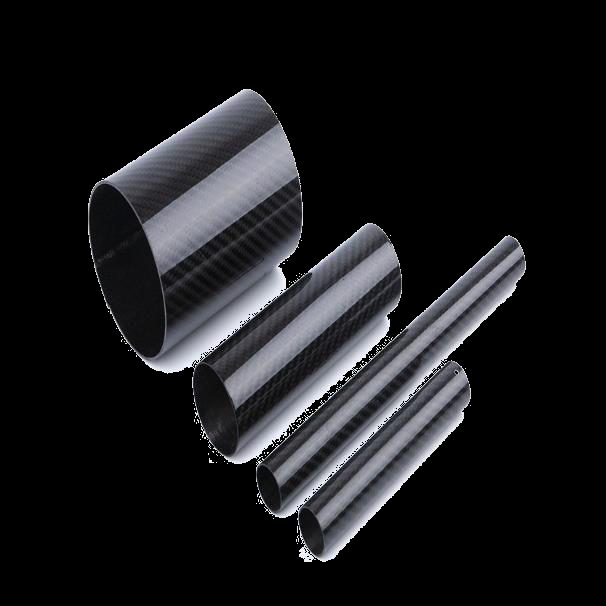
"Should this part be carbon fiber or metal?" is one of the most common questions engineers ask us. The right answer depends on how much the weight saving is worth to you, the load case, and the volume. Here is a straight comparison and a simple decision framework.
The numbers: density, strength, stiffness
The reason carbon fiber replaces metal is specific performance — strength and stiffness per unit weight. The figures below are typical for a quasi-isotropic carbon/epoxy laminate versus common structural metals; real values depend on layup and alloy.
| Property | Carbon fiber | Aluminum (6061) | Steel (mild) |
|---|---|---|---|
| Density (g/cm³) | 1.5–1.6 | 2.7 | 7.85 |
| Specific strength | Very high | Medium | Low–medium |
| Specific stiffness | Very high | Medium | Medium |
| Fatigue resistance | Excellent | Poor (no fatigue limit) | Good |
| Corrosion | Does not rust | Oxidizes | Rusts |
| Tunable properties | Yes (layup) | No | No |
| Raw cost / kg | High | Low | Lowest |
The headline: carbon fiber composite is roughly 40% lighter than aluminum and 80% lighter than steel by volume, and because it is also stiffer per gram, a properly redesigned part is often 30–50% lighter than its aluminum equivalent at the same stiffness.
Fatigue, corrosion and temperature
Two carbon fiber advantages are easy to overlook. First, fatigue: aluminum has no true fatigue limit, so parts under repeated load eventually crack; carbon fiber laminates tolerate millions of cycles far better, which is why they suit drone arms, bike parts and structural booms. Second, corrosion: carbon does not rust, so it thrives in marine and outdoor use with only a UV topcoat.
Two cautions: bonding carbon directly to aluminum can cause galvanic corrosion (isolate the two with a barrier ply or adhesive), and standard epoxy carbon parts are limited to roughly 120–150°C — for higher temperatures we use high-temp resins or a thermoplastic composite such as LFT with PPS or PEEK.
Cost: material vs total cost of ownership
Per kilogram, carbon fiber costs more than aluminum or steel — that is real. But buyers who only compare material price miss where carbon actually wins:
- The weight saving has value. In a drone, EV or aircraft, every gram removed buys range, payload or speed. In shipped consumer goods it lowers freight.
- Part consolidation. A molded carbon or LFT composite part can replace an assembly of several metal parts plus fasteners — removing tooling, assembly labor and failure points.
- No corrosion maintenance over the product life.
For lower volumes needing high strength, LFT injection molding can hit a lower unit cost than hand-laid carbon while still replacing metal — see LFT vs SFT vs prepreg.
When switching to carbon fiber pays off
A quick decision framework — carbon fiber usually wins when several of these are true:
- Weight directly drives value (range, payload, speed, handling, freight).
- The part sees bending, torsion or fatigue rather than concentrated point loads.
- You can consolidate multiple metal parts into one molded part.
- The environment is corrosive (marine, outdoor, chemical).
- Stiffness or vibration damping matters (optics, robotics, imaging).
Metal is often the better call when weight is not valuable, volumes are tiny with a hard budget, the part needs high all-direction electrical or thermal conductivity, or it sees heavy wear and impact on small contact areas.
Two routes: layup vs molded composite
If you switch, there are two main routes. Prepreg layup (roll-wrapping, compression, autoclave) gives the highest performance for tubes, plates and structural parts. Molded composite — LFT long-fiber or SFT short-fiber injection molding — suits complex 3D parts at higher volume with metal-replacement strength. Send us the metal part you want to replace, its load case and your annual volume, and we will recommend the route, quantify the weight saving and quote it.